DeepInfer by DeepSeek-AI: A New High-Performance Inference Framework Trending on GitHub
DeepSeek-AI's DeepInfer, a high-performance, large-scale inference framework designed for DeepSeek models, has rapidly become one of the most-starred projects this season. Launched just ten days ago, it has already garnered 22716 stars and 2635 forks, highlighting significant community interest. Written in Python, DeepInfer aims to optimize the inference process for large-scale AI models. This project's swift rise underscores the ongoing demand for efficient and scalable tools in the AI development landscape. Its popularity suggests a critical advancement in making sophisticated AI models more accessible and practical for broader application.

AI Reveals Critical Vulnerabilities in PHP, Causing Global Website Shutdowns
Websites worldwide have been taken offline after AI revealed critical vulnerabilities in the PHP programming language, which powers a significant portion of the internet. According to BBC News, a researcher using artificial intelligence discovered two critical flaws in PHP, which cybersecurity experts describe as the most severe vulnerabilities ever found by AI. Governments and agencies, including the US National Security Agency, are urging immediate action, with some ordering systems offline if fixes cannot be applied promptly. The widespread shutdowns aim to protect organizations from serious cyber attacks, as malicious actors are reportedly using their own AI to exploit the unpatched flaws.
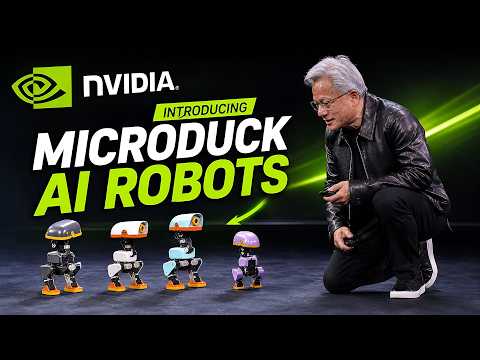
Nvidia Microduck AI Robots Unveiled at GTC Berlin 2026, Showcasing Sim-to-Real World Movement
REC Anything reports that Nvidia CEO Jensen Huang unveiled Microduck AI robots at GTC Berlin 2026. Developed by Hugging Face and France’s Pollen Robotics, these open-source, duck-shaped machines, approximately 25 centimeters tall, demonstrated how NVIDIA AI technology translates simulated learning into real-world movements. The video showcases the robots walking, sitting, and responding to commands, with Huang highlighting a robot-training workflow utilizing NVIDIA Isaac Lab, Isaac Sim, and the Newton physics engine. According to Huang, the robots were created on RTX Spark and trained in the cloud on Nvidia supercomputers, learning skills in an Omniverse digital twin, with Pollen Robotics cited as their creators. The demonstration emphasizes the progress and challenges in autonomous robotics, stating that the Microduck robots are currently sold out.